Replacing a Bathroom Vanity: Sizes, Offset Sinks & Plumbing
Updated 2026-10-30 · Sources verified 2026-07-20
Common sizes: Ferguson Home's vanity guide puts single-sink vanities at 24 to 61 inches wide and double-sink vanities at 48 to 80 inches, with the top overhanging the cabinet by 'an inch or more'. Permit in Orange County: no permit needed. Exempt finish work under FBC 105.2 and Orange County's published list — but exempt work must still comply with the Florida Building Code. The full rule and its official source are below, with the code requirements and mistakes that trip up Orlando homeowners.
Key facts before you start
- Measure before you shop, in this order: the width you have wall to wall (or wall to toilet), then where the drain and the two supply stubs come out of the wall, measured from the side wall and up from the floor. The new cabinet's open back and its drawers have to clear those three pipes. A sink that is 'offset' (set left or right of center) only lands on a centered rough-in if the drain still falls inside the sink base, so match the sink position to the pipes you have, not the other way around.
- Common sizes: Ferguson Home's vanity guide puts single-sink vanities at 24 to 61 inches wide and double-sink vanities at 48 to 80 inches, with the top overhanging the cabinet by 'an inch or more'. Height is a choice: 36 inches ('the same as standard kitchen cabinets') for a primary bath, 32 to 34 inches as the compromise for a guest bath shared by adults and kids, about 30 inches for a kids' bath. A taller cabinet means the old supply stops and drain stub may sit lower in the cabinet than before; a shorter one can leave the trap with no room.
- Code spacing that catches small bathrooms (Florida Building Code, Plumbing 405.3.1): a lavatory 'shall not be set closer than 15 inches from its center to any side wall, partition, vanity or other obstruction', adjacent fixtures no closer than '30 inches center to center', and 'not less than a 21-inch clearance in front' of the sink or toilet. Going wider than the old vanity can break the 15-inch rule at the toilet; a double vanity under 60 inches usually breaks the 30-inch one.
- Removal: shut the two stops under the sink (if they won't close or they weep, close the house valve and plan to replace them), disconnect the supply lines and the slip nuts on the P-trap with a bucket under it, cut the caulk line between the top and the wall and the base and the floor with a utility knife, then back out the screws through the cabinet's rear rail into the studs. Tops are usually bedded in caulk: pry gently from the back edge. Expect unpainted wall, a flooring gap, and a cut baseboard behind the old footprint if the new vanity is smaller or shallower.
- The wall is the installation. Kohler's vanity guide calls for '3/4 inch plywood' backing 'at least 30 inches long' behind the back rail and fasteners rated for a 'min 50 lb' load, and a Style Selections manual puts it plainly: the vanity 'MUST be secured to the wall', drilled 'through vanity mounting area into wall studs', 'to two wall studs for increased stability' if possible. On Orlando block exterior walls there are no studs behind the furring: use masonry anchors into the block (see the TV-mounting guide).
- Plumb and level before anything goes on top. Kohler: 'The vanity must be level before proceeding', shim or turn the leg levelers, and seat the cabinet flush to the finished wall; it 'is designed to allow most base moldings to pass behind the vanity', but remove any molding that holds it off the wall. The supply nipples 'must extend 3 inches beyond the finished wall material', and the supply stops 'when fully open, must not extend more than 3 inches from the wall' or the cabinet back won't close around them.
- Faucet and drain go on the top before the top goes on the cabinet (Lowe's tip: 'it may be easier to install your choice of faucet before securing the vanity top'; Kohler: 'Install the faucet to the lavatory following the faucet manufacturer's instructions', then 'Connect the drain and supplies'). Sealant choice matters: Kohler says 'Siliconized acrylic caulk must be used to secure the lavatory to the vanity. Do not use 100% silicone sealant, which will damage the finish of the vanity', a 1/8-inch bead at each corner and along the side rails, 'Do not apply siliconized acrylic caulk to the front of the vanity'. A small bead where the top meets the wall; code requires it: 'Joints formed where fixtures come in contact with walls or floors shall be sealed' (FBC-P 405.6).
- Offset sink, centered drain (or the reverse): the drain tailpiece and the wall stub no longer line up. The code gives you room: from the sink outlet, the trap can sit up to '24 inches' lower and the trap inlet up to '30 inches' sideways (FBC-P 1002.1). Inside that box, an Oatey Form-N-Fit flexible tailpiece bends to line up: 'Bend the Form-N-Fit slip tailpiece to needed position so it will align with tailpiece and drain connection below. Measure and cut to required length', washer against the fitting, 'Use reducer washer if tailpiece is 1-1/4 in', then 'Tighten nuts. CHECK for LEAKS.' Keep the P-trap itself a proper P: an 'S' trap is prohibited (1002.3) and the trap seal must be 2 to 4 inches (1002.4).
- Replacing the shut-off stops while the cabinet is out is the cheap moment to do it. BrassCraft: 'Be sure to shut off water before starting', the stub-out must be 'square, round and free of burrs', slide the nut and sleeve on, 'Hand tighten the compression nut onto the stop as far as it will allow', then 'tighten 3/4 turn from the hand tight position' with the stop 'square to the copper tube'; 'DO NOT USE a putty, gasket material or thread seal tape' on compression threads, 'DO NOT OVERTIGHTEN', and 'inspect annually, replace if damaged, deterioration or corrosion is detected'. New braided supply lines with the new stops, never the old ones.
- Permit: Orange County's own list of work that needs no permit includes 'Replacing cabinets or countertops in the same location (without changing the layout)', and a vanity is a cabinet with a countertop, so a same-spot swap on the existing drain and supplies is on that list. The same page says most 'plumbing ... work does require a permit': moving the drain or supply stubs inside the wall to suit an offset sink, adding a second sink, or replacing pipe is plumbing-permit work for a licensed plumber or an owner-builder permit. Inside the City of Orlando, Winter Garden, Ocoee or Apopka, confirm with that city's office.
The permit answer
Source: https://codes.iccsafe.org/s/FLBC2023P1/chapter-1-scope-and-administration/FLBC2023P1-Ch01-SubCh02-Sec105.2
Orange County and the City of Orlando run separate permit offices with separate portals — and your mailing address alone doesn't tell you which one covers your home. Check which permit office covers your address →
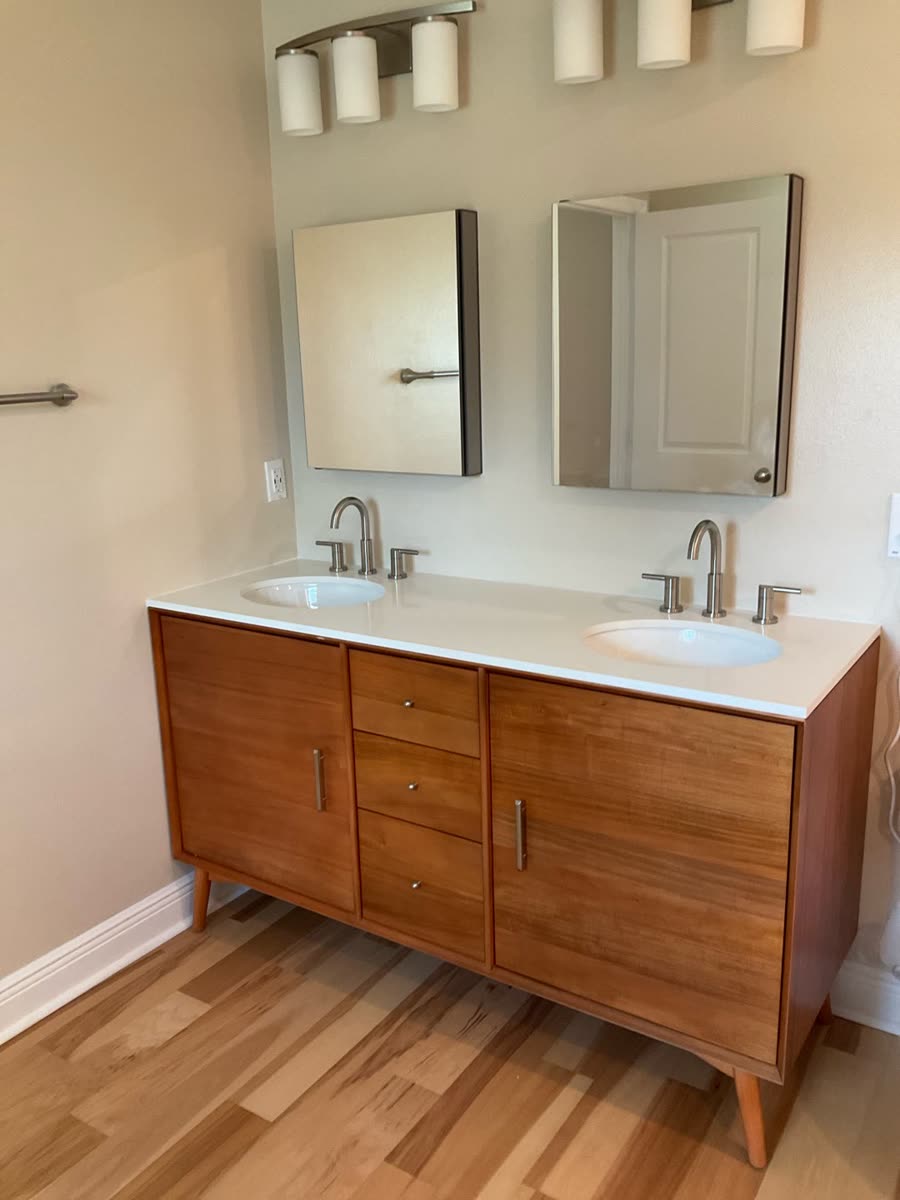
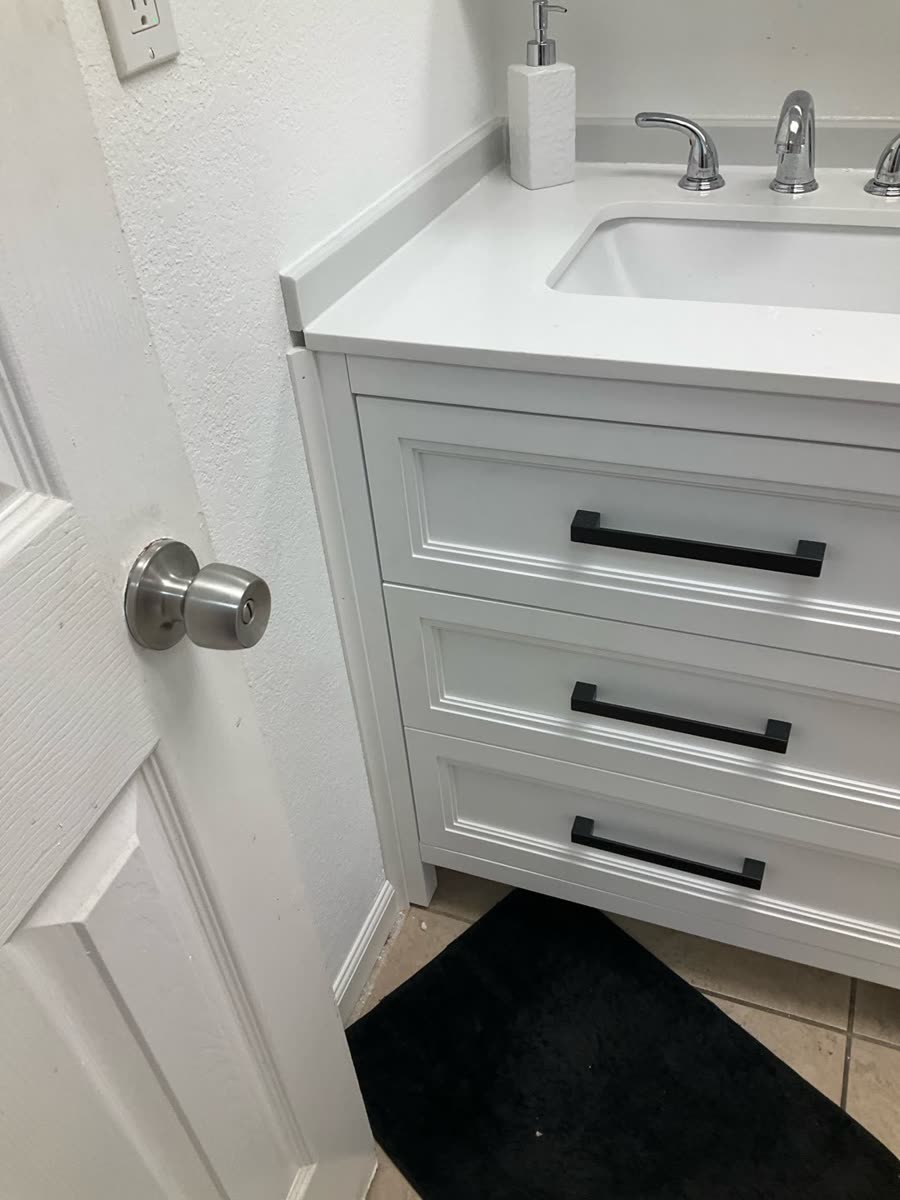
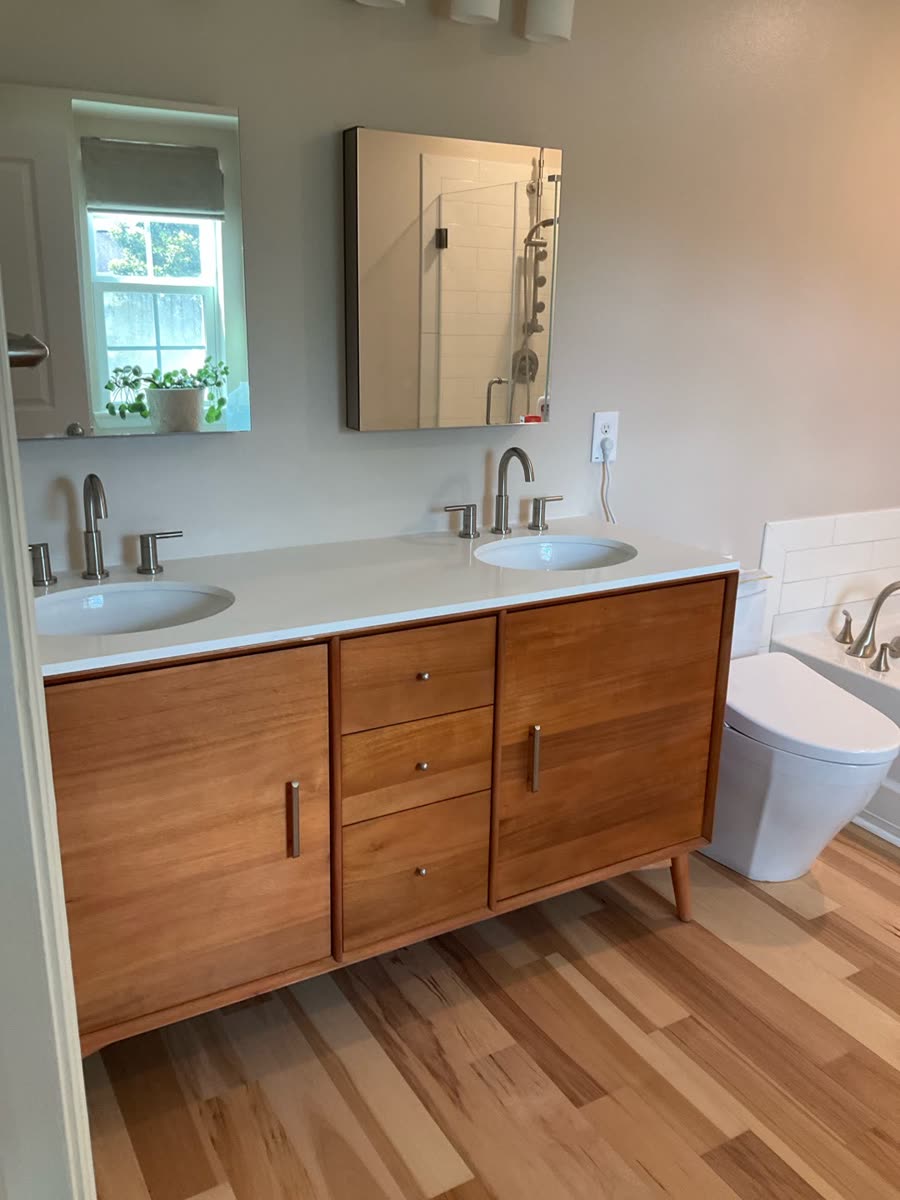
Bathroom Vanity Replacement: what it looks like
Manufacturer instructions
The manufacturers' own instructions this guide is built from. Follow the manual for your exact model; they open on the manufacturer's site.
Get a free step-by-step plan for YOUR exact repair →DIYrr builds a personalized plan from a photo and description — tools, materials with local prices, and permit guidance. Email it to yourself to keep it. Free for homeowners, no account needed.
Frequently asked questions
Do I need a permit for a bathroom vanity replacement in Orange County, FL?
No permit needed. Exempt finish work under FBC 105.2 and Orange County's published list — but exempt work must still comply with the Florida Building Code.
What's the most common mistake homeowners make with a bathroom vanity replacement?
Offset sink, centered drain (or the reverse): the drain tailpiece and the wall stub no longer line up. (1002.4)
Are there specific building-code requirements for a bathroom vanity replacement?
Code spacing that catches small bathrooms (Florida Building Code, Plumbing 405.3.1): a lavatory 'shall not be set closer than 15 inches from its center to any side wall, partition, vanity or other obstruction', adjacent fixtures no closer than '30 inches center to center', and 'not less than a 21-inch clearance in front' of the sink or toilet.
Did this guide help?
Looking for a different repair?
Related repairs
- Bathroom Faucet Replacement in Orlando, FL →
- Cast Iron Drain Pipe & Repipe repair in Orlando, FL →
- Faucet / Shower Cartridge (Moen 1222/1225 · Delta 1300/1400) repair in Orlando, FL →
- Garbage Disposal repair in Orlando, FL →
- Hose Bib / Outdoor Spigot repair in Orlando, FL →
- Kitchen Faucet Replacement in Orlando, FL →
- Washer order and trap rules for the new drain →
- Block wall behind the vanity? Masonry anchors, not studs →
- Patch the wall the old vanity hid →
Sources
https://www.fergusonhome.com/vanity-buying-guide/a23220
https://up.codes/viewer/florida/fl-plumbing-code-2023/chapter/4/fixtures-faucets-and-fixture-fittings#405.3.1
https://up.codes/viewer/florida/fl-plumbing-code-2023/chapter/10/traps-interceptors-and-separators#1002.1
https://techcomm.kohler.com/techcomm/pdf/1105377-2.pdf
https://techcomm.kohler.com/techcomm/pdf/1524731-2.pdf
https://pdf.lowes.com/productdocuments/cacc48e8-578f-4cb3-87ba-62c5e2329c4a/09536610.pdf
https://images.homedepot-static.com/catalog/pdfImages/8f/8f5e7911-f54b-4425-b7ed-b7eb0c92724d.pdf
https://d2cl5to9q9oami.cloudfront.net/doc/425.04_WaterStops_INS.pdf
https://engageorange.ocfl.net/fast-track-permitting-services/faqs
This guide is general informational content, not professional or legal advice. Codes and county rules change — confirm permit requirements with your local building department, and use a licensed professional for electrical, gas, structural, or main-line plumbing work.
© 2026 Karhan Companies LLC · Orlando, FL · DIYrr app · All guides · Tips library · About · Contact · Privacy · Terms